





Courier Management Software in Spain: Digitize Your Delivery Operations with CodeCom Courier System

ccdev
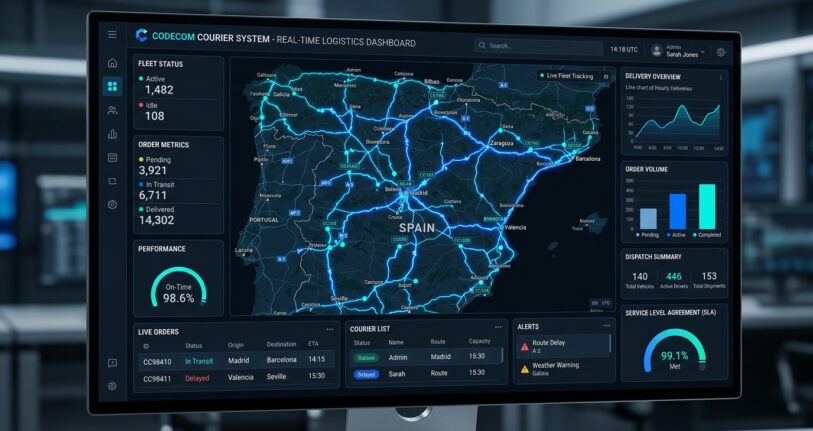
Operating a courier or delivery company in today’s high-velocity commerce environment is a delicate balancing act. Dispatchers coordinate drivers across congested metropolitan corridors, customer support teams field continuous inquiries about parcel status, and operations managers grapple with unpredictable delivery schedules. When order volumes expand, paper-based manifests, spreadsheet trackers, and disconnected messaging channels quickly become bottlenecks that compromise service quality and erode operating margins.
For logistics and courier operators in Spain—navigating dense urban centers such as Madrid, Barcelona, and Valencia alongside expansive regional distribution networks across Andalusia, Catalonia, and Galicia—operational friction carries a steep cost. Growing customer expectations for real-time shipment transparency and predictable delivery windows require a departure from fragmented, manual workflows toward integrated, digital infrastructure.
Meeting these operational demands requires specialized technology designed specifically for courier workflows. CodeCom Courier System, developed by CodeCom.dev, provides a centralized delivery and courier management platform that connects dispatchers, drivers, and customers into a unified operational environment. Whether handling same-day urban parcels, B2B transport, or regional last-mile distribution, the system is engineered to replace operational fragmentation with clarity and control.
1. What Is Courier Management Software?
Courier management software—often categorized within the broader realm of transportation management systems (TMS) or software de gestión de transporte—is a specialized digital platform designed to oversee, automate, and streamline the lifecycle of a parcel from order intake to final-mile handover.
Unlike generic spreadsheet trackers or standard inventory tools, courier management software addresses the time-sensitive, dynamic realities of physical transportation. At its core, the software synchronizes four primary stakeholders in real time:
- The Administration and Management Team: Overseeing operational performance, configuring service types, setting pricing policies, and analyzing overall business health.
- The Dispatch Office: Assigning orders, balancing vehicle capacities, monitoring route progression, and resolving exceptions as they arise.
- The Field Drivers and Couriers: Receiving dispatch instructions, capturing digital signatures, recording exceptions, and navigating delivery stops through a dedicated mobile interface.
- The End Customer (Sender and Consignee): Placing transport orders, tracking parcel movement through self-service portals, and receiving proactive delivery milestones.
A comprehensive courier platform integrates multiple operational modules into a cohesive pipeline:
- Order Capture and Booking: Ingesting delivery orders via web portals, API connections with eCommerce merchants, or manual administrative entry.
- Intelligent Dispatching: Allocating consignments to the appropriate fleet driver or partner carrier based on operational criteria, delivery zones, or driver availability.
- Live Operational Visibility: Monitoring active driver locations, delivery progress, and completed stops throughout the business day.
- Mobile Driver Workflows: Supplying field couriers with structured digital manifests, step-by-step stop details, and digital proof-of-delivery tools.
- Customer Communication: Triggering automated delivery status alerts via SMS, email, or messaging webhooks.
- Proof of Delivery (POD): Capturing verifiable, tamper-evident delivery confirmations, including digital signatures, photographic records, GPS coordinates, and timestamp logs.
- Billing, Rating, and Invoicing: Calculating transport charges based on distance, volumetric weight, zone parameters, or negotiated service-level agreements (SLAs).
By consolidating these functions into a single platform, CodeCom Courier System eliminates data silos, minimizes manual double-entry, and provides logistics operators with the operational clarity required to run dependable delivery services.
2. Why Courier Companies Need a Digital Management System
Many delivery companies begin operations with lean, ad-hoc workflows: dispatchers assign runs via phone calls or messaging apps, drivers record drop-offs on paper delivery notes (albaranes), and administrators tally billing details in spreadsheets at the end of the week. While viable for micro-fleets handling a handful of daily deliveries, this fragmented approach rapidly destabilizes as order volumes climb.
The Operational Pitfalls of Manual Workflows
- Information Latency and Disconnects: If a dispatcher does not know a driver’s exact status or current location, reallocating urgent same-day collections becomes an exercise in guesswork.
- Customer Service Overload: Without public tracking capabilities, senders and recipients inundate support staff with repetitive “Where is my parcel?” inquiries, driving up administrative overhead.
- Disputed Deliveries and Liability Claims: Paper receipts get lost, smudged, or misfiled. In the absence of definitive, timestamped proof of delivery with photo or signature verification, courier companies frequently absorb unjustified financial liability for disputed drop-offs.
- Billing Inaccuracies and Revenue Leakage: Manual transcription of paper manifests into billing software invites calculation errors, missed surcharges (such as wait times or redeliveries), and substantial invoicing delays that constrain cash flow.
- Driver Inefficiencies and Burnout: Unstructured delivery sequences force drivers to spend excessive time organizing paperwork and planning stops manually rather than executing drop-offs efficiently.
The Power of Operational Centralization
Transitioning to a digital delivery management platform resolves these structural weaknesses by establishing a single source of truth. When an order is registered, it instantly populates the dispatcher’s console, becomes visible for scheduling, syncs to the designated courier’s mobile device, and generates a trackable reference for the customer.
Centralization transforms reactive logistics into proactive operational control. Instead of answering calls to locate drivers, dispatchers monitor operational progression on live dashboards. Instead of sorting physical paperwork, accounting teams generate accurate, audit-ready billing records directly from completed digital delivery events. CodeCom Courier System is engineered to serve as this centralized operational hub.
3. CodeCom Courier System: Platform Overview
CodeCom Courier System is a dedicated delivery management and logistics software platform built by CodeCom.dev. Engineered to address the operational complexities of transport businesses, it bridges administrative dispatch oversight with frontline driver execution.
Rather than imposing rigid, unalterable workflows that force courier companies to reconfigure their core business practices, CodeCom Courier System is built as a flexible, modular software foundation. It delivers the core functional architecture necessary to run an end-to-end courier service, while offering extensive configuration and custom engineering options to align with specific regional, operational, and commercial requirements.
The system provides three primary interaction touchpoints:
- The Central Management & Dispatch Console: A secure web-based back office where operations teams configure system rules, manage vehicle profiles, process orders, monitor active fleet movements, and handle financial reconciliation.
- The Driver Mobile Experience: A structured mobile interface enabling couriers to view their daily run sheets, accept or reject assignments, access recipient contact details, and record verifiable proof of delivery in the field.
- The Customer Tracking Interface: A branded, self-service tracking environment where clients and consignees can query parcel status using tracking numbers, inspect delivery milestones, and view digital delivery receipts.
4. Core Capabilities of CodeCom Courier System
Order Management (Gestión de Pedidos)
The order management module serves as the primary intake engine of the platform, transforming customer shipment requests into structured, actionable transport jobs:
- Flexible Consignment Creation: Orders can be registered manually by dispatch operators, submitted directly by clients through a self-service ordering interface, or imported programmatically via API connections with eCommerce shopping carts and warehouse management systems.
- Detailed Shipment Attributes: Captures comprehensive consignment data, including sender details, recipient coordinates, declared values, package counts, weight, dimensions, fragile flags, and custom delivery instructions.
- Granular Status Tracking: Assigns precise lifecycle statuses to every shipment—such as Draft, Confirmed, Allocated, Out for Pickup, Received at Hub, Out for Delivery, Completed, or Exception.
- Batch Import Capabilities: Supports the bulk ingestion of delivery spreadsheets (CSV/Excel) for B2B contracts requiring hundreds of daily point-to-point dispatches.
Driver Management (Gestión de Conductores)
Drivers represent the primary operational asset and cost center for any courier organization. CodeCom Courier System structures fleet management into an organized digital directory:
- Driver Profiles and Documentation: Stores driver contact details, license categories, assigned vehicle types (motorcycle, van, rigid truck), and operational status.
- Status Monitoring: Dispatchers can verify which drivers are active, on duty, on scheduled breaks, or offline, preventing allocation errors during shift transitions.
- Capacity and Zone Assignment: Allows administrators to link drivers to specific operating zones, postal code prefixes, or dedicated customer accounts.
Driver Mobile Application Workflows
The driver mobile interface serves as the physical link between operational planning and ground-level execution:
- Digital Run Sheets: Eliminates physical paper manifests by streaming assigned pickups and drop-offs directly to the driver’s device in real time.
- Detailed Consignment Briefing: Drivers can inspect recipient notes, gate entry codes, special handling instructions, and cash-on-delivery requirements with a single tap.
- Status Updates from the Field: When a courier marks an order as “Arrived” or “Delivered,” the central dispatch console and customer tracking portals update synchronously.
- Navigation Integration: Can be configured to pass destination coordinates directly into the driver’s preferred on-device navigation tools (such as Google Maps or Waze).
Delivery Tracking & Operational Visibility
- Dispatch Fleet Oversight: Provides dispatch teams with a clear overview of active runs, identifying bottlenecks or delayed drop-offs before they escalate into customer complaints.
- Public Tracking Pages: Offers end customers a clean, branded tracking interface where entering a consignment or reference number displays the current operational milestone.
- Milestone Auditing: Every status change is logged with an immutable audit trail, recording exactly when an order transitioned between logistical stages.
Dispatch Management
- Manual and Semi-Automated Allocation: Dispatchers can assign individual orders or entire batches of shipments to drivers based on proximity, route suitability, or vehicle capacity.
- Dynamic Reassignment: If a delivery vehicle encounters mechanical issues or heavy traffic delays, controllers can reassign pending stops to another nearby driver without disrupting downstream operations.
- Exception Handling: Flags failed delivery attempts (e.g., recipient absent, incorrect address, access restricted) immediately, allowing dispatchers to issue redelivery instructions or schedule hub returns.
Route Organization & Stop Sequencing
- Structured Stop Sequences: Organizes delivery stops logically based on geographical clustering and scheduled delivery time windows.
- Daily Run Structuring: Assists dispatchers in organizing morning loading patterns so that parcel loading matches the physical sequence of delivery drop-offs.
- Scalable Routing Configuration: CodeCom.dev can integrate specialized routing engines, custom optimization algorithms, or mapping services according to project scope and operational needs.
Proof of Delivery (POD / Prueba de Entrega)
- Sign-on-Glass Technology: Captures recipient signatures directly on the courier’s mobile touchscreen, pairing the signature with the printed recipient name.
- Photographic Verification: Couriers can capture and upload photographic proof showing where a parcel was deposited—ideal for unattended drop-offs, safe-place deliveries, or documenting damaged packaging prior to handover.
- Automated Geotagging & Timestamps: Automatically binds the exact GPS latitude/longitude and system timestamp to the delivery record at the moment of completion.
- Instant POD Archiving: Generates digital delivery receipts that are immediately accessible to administrative staff and can be made available for customer download.
Customer Portal & Self-Service Experience
- B2B Client Dashboards: Commercial accounts can log into a dedicated portal to book collections, generate shipping labels, and track open orders.
- Delivery History & Invoicing Access: Business clients can review their historical transport records, examine archived PODs, and inspect billing statements without calling customer service.
Automated Notifications
- Configurable Notification Triggers: The system can be configured to trigger notifications at critical lifecycle moments—such as when an order is confirmed, out for delivery, or successfully completed.
- Omnichannel Delivery: Can be integrated with SMS gateways, automated email services, or third-party messaging platforms (such as WhatsApp Business API).
Reporting, Analytics & Performance Metrics
- Fleet Activity Metrics: Evaluates driver performance by analyzing completed drop-offs, average stop durations, and on-time completion rates.
- Operational Volume Trends: Identifies seasonal spikes, high-density delivery zones, and volume shifts across geographic sectors.
- Exportable Data Sets: Facilitates data exports (CSV, Excel, JSON) for financial modeling, external business intelligence (BI) tooling, or management reporting.
Pricing, Rating & Billing Workflows
- Multi-Tier Rating Rules: Configurable logic to calculate transport charges based on base fees, distance bands, weight thresholds, or dedicated customer tariff schedules.
- Surcharge Configurations: Supports configurable surcharges for out-of-area deliveries, weekend services, hazardous goods, or redelivery attempts.
- Invoicing Preparation: Consolidates completed, verified transport jobs into structured billing data ready for transfer to external accounting systems.
5. CodeCom for Different Delivery Business Models
| Delivery Model | Primary Operational Challenge | CodeCom Platform Solution |
|---|---|---|
| Local Courier Services | Fast-turnaround, on-demand dispatching within cities | Instant job allocation, live courier map tracking, fast digital POD |
| Last-Mile Delivery | High stop density, tight delivery windows, recipient absence | Stop sequencing, automated arrival notifications, photo verification |
| eCommerce Logistics | High order volumes, merchants needing system integrations | Bulk order import, automated shipping APIs, branded customer tracking |
| B2B Transport & Freight | Documentation compliance, multi-stop scheduled routes | Digital albarán storage, weight-based rating, client booking portal |
| Regional Courier Networks | Multi-hub handovers, inter-provincial trunking | Multi-depot status tracking, branch-level user permissions |
| Growing Logistics Startups | Rapidly shifting processes, scaling past spreadsheets | Modular architecture, custom-built feature extensions as business grows |
6. Customization and Architectural Flexibility
A primary challenge facing delivery businesses when selecting software is the rigidity of off-the-shelf software-as-a-service (SaaS) products. Pre-packaged applications are built to satisfy the broad, average needs of the market. Consequently, when a business maintains a unique delivery workflow, a specialized pricing algorithm, or a proprietary operational process, standard SaaS platforms force the business to compromise its operational identity.
As a software development firm, CodeCom.dev does not merely provide access to a static software license; we partner with transport operators to adapt the platform to their operational blueprint:
- Tailored User Interfaces: Designing dashboard layouts that highlight the metrics and operational views most relevant to your dispatchers.
- Custom Workflow Transitions: Introducing customized order lifecycle steps that mirror your internal standard operating procedures (SOPs).
- Proprietary Feature Development: Building dedicated modules—such as specialized container-tracking capabilities, multi-depot cross-docking workflows, or driver settlement tools.
7. System Integrations and Technical Connectivity
Modern courier businesses do not operate in a technological vacuum. The efficiency of a delivery company depends directly on how smoothly its dispatch platform communicates with surrounding enterprise applications.
CodeCom Courier System is engineered with connectivity at its foundation, capable of interfacing with a wide range of external systems based on project scope:
- eCommerce Platforms: Integrations can be engineered for platforms such as WooCommerce, Shopify, Magento, or PrestaShop, pulling completed customer orders directly into the courier dispatch queue.
- Enterprise ERP & Warehouse Systems: Exchanging transport orders and fulfillment records with enterprise systems such as SAP, Microsoft Dynamics, Odoo, or proprietary internal databases.
- Mapping & Geolocation Services: Integrating industry-standard mapping APIs (such as Google Maps Platform, Mapbox, or OpenStreetMap) for visual fleet representation and route planning.
- Payment Gateways & Cash on Delivery (COD): Tracking collected funds systematically through the driver application and integrating payment processing services.
- Invoicing & Financial Software: Exporting completed delivery data into accounting platforms (such as Factusol, Holded, or Sage) to automate billing generation.
8. Strategic Business Benefits for Courier Operators
- Significant Reduction in Administrative Overhead: Eliminating physical paper trails and disconnected spreadsheets reduces the manual labor required to manage daily consignments.
- Elimination of Disputed Deliveries: Digital sign-on-glass captures, photographic drop-off records, and automatic GPS timestamps provide an indisputable audit trail that protects operating revenue.
- Reduced Inbound Support Calls: Self-service tracking portals and automated milestone notifications allow support teams to pivot from answering tracking questions to addressing substantive customer needs.
- Improved Driver Accountability and Productivity: Structured mobile manifests eliminate ambiguity in the field, while fleet managers maintain clear visibility over route progression.
- Seamless Business Scalability: Centralized digital operational pipelines allow businesses to scale their delivery volumes without a linear increase in administrative headcount.
9. Ready-Made SaaS vs. Custom-Built Courier Software
| Consideration | Standard Off-The-Shelf SaaS | Custom Scratch Build | CodeCom Hybrid Approach |
|---|---|---|---|
| Initial Deployment | Rapid setup (days) | Extended timeline (months/years) | Fast baseline deployment |
| Workflow Alignment | Forces business to adapt to tool | Built to exact specification | Core adapted to your workflows |
| Long-Term Costs | Monthly per-driver/order fees | Substantial upfront capital | Transparent project-based pricing |
| Integration Flexibility | Limited to pre-built marketplace | Unlimited but costly to build | Tailored to your specific stack |
| Competitive Edge | Identical to your competitors | Unique operational IP | Custom features build advantage |
10. Understanding the Cost Factors of Courier Software
Because every delivery business operates at a different scale, with distinct fleet compositions and integration requirements, the cost of implementing courier management software varies based on technical scope:
- Fleet Size and User Concurrency: The number of dispatch controllers, administrative operators, and active couriers who will concurrently interact with the platform.
- Mobile Application Requirements: Whether your operations require a standardized web-based mobile portal or dedicated native mobile applications for Android and iOS.
- Complexity of Routing and Dispatch Logic: The level of dispatch automation required—from structured manual allocation to automated zone-based multi-vehicle stop sequencing.
- Third-Party Integrations: The scope and number of external technical integrations needed (ERP, eCommerce, accounting, SMS gateways, mapping APIs).
- Customer Portal Scope: The functional depth of the client-facing portal—from simple tracking to corporate account dashboards with bulk CSV order uploads.
At CodeCom.dev, we conduct a structured operational requirements review to analyze your fleet structure, volume projections, and integration needs, followed by a transparent proposal tailored to your commercial objectives.
11. Why Partner with CodeCom.dev?
Selecting a logistics software platform is entering into an operational partnership. CodeCom.dev approaches courier software development with the rigor and accountability of an engineering partner:
- Bespoke Engineering Capabilities: We specialize in building web, mobile, and cloud-connected platforms with high-concurrency database architecture and real-time geolocation streaming.
- Practical Operational Focus: We build technology around the practical demands of dispatchers and drivers, delivering intuitive interfaces that minimize training time and prevent mistakes.
- Commitment to Technical Adaptability: As your logistics enterprise diversifies or expands geographically, our engineering team can adapt and scale your platform accordingly.
12. CodeCom Courier System for the Spanish Delivery Market
The logistics and courier market in Spain presents distinct operational conditions that make modern digital infrastructure essential:
- Urban Last-Mile Precision: Navigating congested city centers in Madrid, Barcelona, or Seville demands precise delivery sequencing and rapid proof-of-delivery execution to minimize vehicle idling and parking complications in Low Emission Zones (Zonas de Bajas Emisiones – ZBE).
- Multi-Modal Courier Fleets: Courier operations in Spanish cities frequently utilize diverse fleets—combining electric cargo bikes, scooters, and light commercial vans with larger distribution trucks for peripheral warehouse runs. CodeCom Courier System can manage diverse vehicle profiles within a unified dispatch environment.
- Regional and National Carrier Collaboration: Many regional courier firms in Spain act as local delivery partners for national networks, requiring clean documentation handovers, structured albaranes, and rapid POD exchanges to maintain partner compliance.
- Strict Data Privacy Standards: Operating within Spain and the European Union necessitates strict adherence to General Data Protection Regulation (GDPR / RGPD) requirements. CodeCom Courier System is built with secure authentication, role-based access permissions, and auditable data retention policies.
Frequently Asked Questions (FAQ)
What is courier management software?
Courier management software is a specialized technology platform used by delivery and logistics businesses to oversee and automate their transport operations. It centralizes order booking, dispatching, driver mobile workflows, real-time package tracking, digital proof of delivery (POD), and billing reconciliation into a single unified system.
What is the best courier management software for a delivery company in Spain?
The best software depends on your operational structure, fleet size, and workflow requirements. While generic off-the-shelf SaaS tools provide standard functionality, an adaptable solution like CodeCom Courier System is often the most effective choice for growing Spanish delivery companies because it combines an established logistics foundation with the flexibility to customize workflows, integrations, and pricing rules to your business model.
Can CodeCom Courier System manage both drivers and delivery orders?
Yes. CodeCom Courier System integrates comprehensive order management (from order entry to status tracking) with robust driver management modules. Dispatchers can manage driver profiles, monitor on-duty availability, assign delivery sequences, and track operational progress directly through the central dashboard.
Does CodeCom Courier System include a mobile application for drivers?
The platform features structured mobile workflows designed specifically for field couriers. Drivers can access their daily manifests, view pickup and delivery instructions, navigate to customer stops, record delivery statuses, and capture verifiable proof of delivery directly on their mobile devices.
What types of proof of delivery (POD) are supported?
CodeCom Courier System can capture multiple forms of digital proof of delivery (prueba de entrega), including digital sign-on-glass customer signatures, photo verification for unattended or safe-place drop-offs, automatic GPS coordinate logging, and timestamp generation to ensure a complete, verifiable audit trail.
Can CodeCom Courier System be customized for unique business workflows?
Yes. Customization and technical flexibility are central strengths of CodeCom.dev. Unlike rigid SaaS platforms, CodeCom Courier System can be adapted to accommodate specific tariff structures, specialized field verification requirements, tailored dispatcher interfaces, and unique operational workflows based on your project requirements.
Can CodeCom integrate with an existing website, eCommerce store, or ERP?
Yes. CodeCom.dev can engineer API integrations connecting CodeCom Courier System with external eCommerce storefronts (such as WooCommerce, Shopify, or PrestaShop), enterprise ERP systems, warehouse management software (WMS), accounting tools, and third-party messaging or mapping services according to your project scope.
How much does it cost to implement CodeCom Courier System?
Software implementation costs depend on your fleet size, required technical modules, mobile deployment requirements, and the complexity of any custom integrations. CodeCom.dev conducts a transparent operational requirements review to provide a tailored, clear proposal based on your exact business needs.
Digitize and Scale Your Delivery Operations Today
Relying on spreadsheets, paper delivery manifests, and disconnected communication channels limits the growth and profitability of your delivery business. In an increasingly competitive transport landscape, operational centralization is the key to protecting margins and delivering dependable customer service.
CodeCom Courier System provides the technological infrastructure required to automate dispatching, empower field drivers, eliminate disputed deliveries, and provide clients with modern shipment tracking.
Whether you operate a local courier service, an urban last-mile delivery fleet, or a regional transport network in Spain, CodeCom.dev can help you deploy a delivery management platform tailored to your operational workflows.
Contact CodeCom.dev for a Consultation:
- Website: CodeCom.dev
- Consultation: Request an operational review and software demonstration tailored to your fleet.